
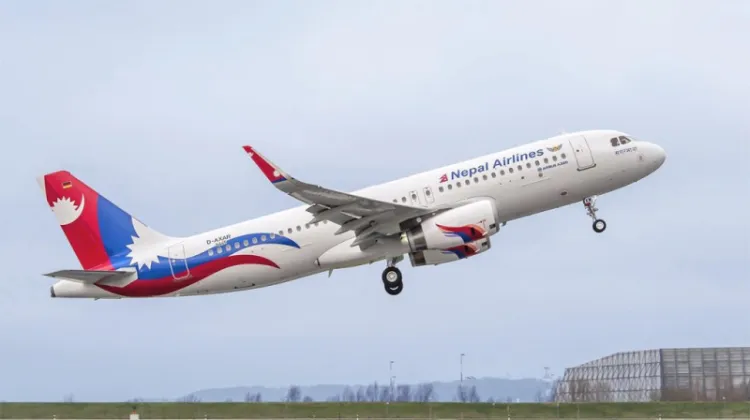
Nepal Airlines' flights to Saudi Arabia have been thrown into uncertainty after the contract of its General Sales Agent (GSA) in the Kingdom expired without renewal, leaving the national flag carrier without an official local representative in a key overseas market. With the process of appointing a new agent yet to move forward, serious questions now surround the continuity of the corporation's operations to the Gulf country.
At the center of the issue is Al Faisaliah Modern Aviation Company, the firm that had been handling Nepal Airlines' sales and other ground-related services in Saudi Arabia. According to a report by Onlinekhabar, the contract with the company has lapsed without renewal, and the effort to bring a replacement on board has made no visible progress, leaving the airline's Saudi operations in a state of limbo.
A contract lapse with operational consequences
The expiry of the GSA agreement means Nepal Airlines no longer has a contracted partner in Saudi Arabia to manage the commercial and service-side functions that keep a foreign airline running in that market. Al Faisaliah Modern Aviation Company had been performing exactly this role, overseeing the corporation's sales and related ground services in the Kingdom, and its departure from that position has not been matched by the arrival of a new appointee.
For a carrier operating internationally as Nepal's national flag airline, representation in a foreign market is not a formality. It is the mechanism through which tickets are sold, customers are served, and the day-to-day coordination required to sustain scheduled services is carried out. The absence of such a mechanism, combined with the delay in appointing a successor, is precisely why concern has arisen over whether the flights themselves can continue as before.
Why the GSA role matters so much
A General Sales Agent occupies a pivotal position in international aviation. Airlines that do not maintain a full commercial office in every country they serve typically delegate a wide range of responsibilities to a local GSA, which then acts as the carrier's face and operational support on the ground. The Onlinekhabar report describes Al Faisaliah Modern Aviation Company's mandate for Nepal Airlines as covering sales and other ground-related services, a scope that captures how central such an agent is to a route's viability.
The functions a GSA typically performs
- Sales and ticketing: promoting the airline's products, selling tickets, and managing relationships with travel agents and customers in the local market.
- Ground-related services: coordinating the on-ground arrangements that passengers and aircraft depend on when a flight arrives and departs.
- Local representation: serving as the airline's point of contact in the country for matters connected to its commercial presence.
Losing that support without an immediate replacement inevitably creates gaps, both in revenue generation and in the servicing of the route. This is why the expiry of a GSA contract, ordinarily a routine administrative matter that is resolved through timely renewal or re-tender, has in this case grown into a question mark over the fate of an entire international operation.
New agent yet to be appointed
What makes the situation more precarious is that the process of appointing a new GSA has yet to move forward. As things stand, Nepal Airlines has neither its previous agent nor a new one in place for the Saudi market.
The report does not specify a timeline for when a new agent might be appointed, nor does it detail what interim arrangements, if any, the corporation is considering. That absence of a clear path forward is itself significant: the longer the vacuum persists, the greater the uncertainty surrounding the future of the service.
What is at stake for the flag carrier
The uncertainty comes at a sensitive moment for the corporation. As Nepal's national flag carrier, Nepal Airlines' international operations are closely watched, and its routes to the Gulf form an important part of its network. Saudi Arabia is a major destination for Nepali migrant workers, which gives the connection a significance that goes well beyond ordinary leisure traffic.
Any prolonged gap in sales and ground support in that market would be felt first by passengers, who rely on the airline's local representation for bookings and assistance, and then by the corporation itself, whose ability to sustain the service depends on the infrastructure a GSA provides.
For now, the situation remains unresolved. The contract with Al Faisaliah Modern Aviation Company has expired, no new agent has been appointed, and the process that would install one has yet to advance. Until the corporation either names a new GSA or puts alternative arrangements in place, the future of its Saudi Arabia operations will remain open to question, and the responsibility for restoring clarity rests with the airline's own decisions on its representation in the Kingdom.


