
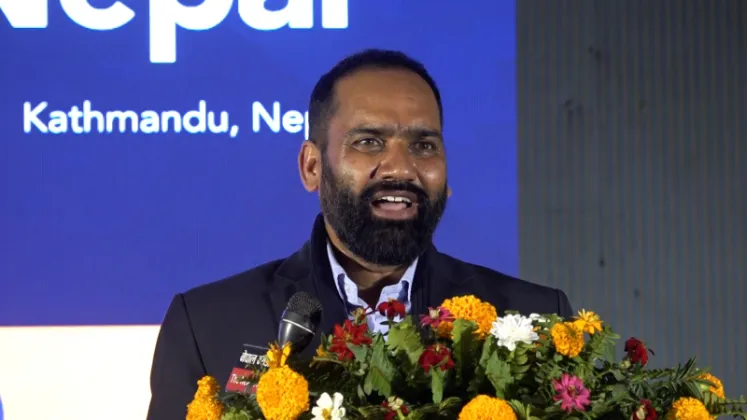
Minister for Culture, Tourism and Civil Aviation Khadka Raj Paudel (Ganesh) has said that the Himalayas are not the property of Nepal alone but a shared asset of the entire world. He made the remark on Thursday while addressing an international climbing and mountaineering event organised by the Nepal Mountaineering Association in Kathmandu, with Nepali media reporting his statement on 29 and 30 October 2026.
Delivered at a gathering that brought Nepal's mountaineering community together with international participants, the minister's comment framed the world's highest mountain range as a natural inheritance whose significance stretches far beyond the country's borders. Coming from the head of the ministry responsible for Nepal's tourism, aviation and mountaineering policy, the statement carries weight both at home and among the international climbers and expedition operators who follow the country's mountain agenda closely.
A Message of Shared Ownership
At the heart of Paudel's statement lies a simple but far-reaching idea: although the Himalayas rise along Nepal's northern frontier, they belong to humanity as a whole. Nepal is custodian of eight of the world's fourteen peaks that rise above 8,000 metres, including Sagarmatha (Mount Everest), the highest point on earth at 8,848.86 metres. Few countries are so closely identified with a single natural feature, and fewer still hold stewardship over so much of the planet's extreme altitude.
By describing the range as a shared asset, the minister positioned Nepal as a custodian rather than a sole proprietor, one that welcomes the world to value the mountains collectively. The framing acknowledges a dual reality: the peaks are woven into Nepal's national identity and economy, yet their allure, their water reserves and even their future are matters of global interest.
Why the Himalayas Matter Beyond Nepal's Borders
The notion of the Himalayas as a global asset rests on realities that are well documented:
- A concentration of the planet's highest peaks. Nepal is home to eight of the fourteen mountains on earth that exceed 8,000 metres, a density of giant peaks unmatched anywhere else.
- Everest's universal pull. Sagarmatha, known internationally as Mount Everest, draws climbers from every continent during the spring and autumn climbing seasons.
- A water tower for South Asia. The Himalayan range feeds river systems on which hundreds of millions of people across the region depend for drinking water, agriculture and hydropower.
- A frontline of climate change. The region's glaciers are among the most sensitive on earth to rising temperatures, keeping the mountains at the centre of international climate research and debate.
Taken together, these factors explain why developments in Nepal's mountains resonate far beyond Kathmandu, and why statements about the range's status attract attention from the international climbing and scientific communities alike.
Mountaineering at the Centre of Nepal's Tourism Economy
The ministry Paudel leads oversees a sector in which mountaineering occupies a prominent place. Nepal's peaks are opened to climbers through a government permit system, and each climbing season brings expeditions, trekking groups, guides, porters and support staff to the mountains, sustaining livelihoods in the country's hill and mountain districts. Spring and autumn are the principal climbing seasons, when favourable weather windows draw the bulk of international expeditions to the highest summits.
Delivering a message of shared ownership at an international climbing event also reflects the nature of the sector itself. Mountaineering in Nepal is, by its very character, an international undertaking: climbers, guides, operators, liaison officers and researchers converge on the country from around the world, and the health of the industry depends on that continuing exchange.
Kathmandu as a Stage for the Global Climbing Community
The event at which the minister spoke was organised by the Nepal Mountaineering Association, a body long associated with the promotion and development of mountaineering in Nepal. International climbing and mountaineering gatherings in the capital provide a forum where government policy, the domestic climbing community and the interests of the global mountaineering world meet, making the venue a fitting stage for a statement about the range's international standing.
Nepali media, including Pradesh Khabar, carried the minister's remarks on 29 and 30 October 2026.
For a country whose name is synonymous with the world's tallest peaks, the message from the tourism ministry was clear: the Himalayas may stand on Nepali soil, but their meaning, and their care, belong to everyone.


