
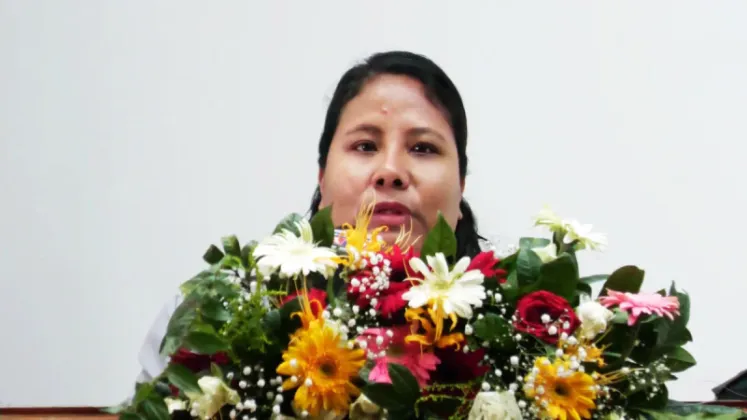
Minister for Agriculture, Forests and Environment Geeta Chaudhary has called for climate justice to be delivered in practice rather than left as a slogan, saying the principle must not be confined to speeches and United Nations documents. She was speaking at the National Climate Summit-2026, held in Kathmandu on Thursday, an event that took up issues including global carbon emissions. Her address, reported by RatoPati and Nagarik News, framed climate justice as a test of seriousness rather than a phrase reserved for formal occasions.
A demand for delivery, not declarations
The heart of the minister's message was a warning about the gap between words and action. According to the reports, she said climate justice should be implemented in practice rather than limited to slogans, and should not remain confined to the pages of UN documents. RatoPati's headline captured the first formulation, while Nagarik News highlighted the second, but both pointed to the same core argument: declarations, however solemn, do not change anything by themselves.
Her key points, as reported, can be summarised briefly:
- Climate justice must be put into practice, not kept as a slogan.
- The principle should not be limited to UN documents.
- It should not remain a matter of rhetoric alone.
Taken together, the three phrasings amount to a single challenge. The minister, in effect, told her audience that climate justice will be measured by what follows the speeches: whether commitments made at forums such as the summit translate into measures that alter outcomes on the ground. The reports of her address do not record her laying out a detailed programme of her own; the force of the intervention lay instead in setting a standard against which future action would be judged.
There is a certain aptness in where the warning was delivered. Summits are, by design, forums built around statements and declarations, which is precisely what makes a call for practice in such a setting pointed. A principle that cannot move beyond the podium, the argument runs, is a principle that will not survive contact with reality.
The summit setting: Kathmandu and the carbon question
The National Climate Summit-2026 provided the backdrop for her remarks. Held in the capital on Thursday, the summit focused on issues including global carbon emissions, placing Nepal's national conversation about climate policy alongside the international debate over where emissions come from and how quickly they must fall.
Emissions occupy that central place for a straightforward reason: they are the driver of a warming planet, and every argument about climate change, from adaptation to finance, ultimately circles back to them. That is also why the language of climate justice has grown so prominent in global discussions. The distribution of emissions and the distribution of climate impacts do not align neatly, and the countries and communities that have contributed least to the problem are frequently those with the fewest resources to withstand its consequences.
Against that backdrop, the minister's decision to press the point at a national summit in Kathmandu carries its own significance. It signals that the question of whether climate justice exists only on paper, or changes what governments actually do, is part of the domestic debate in Nepal as well as the diplomatic one conducted in far larger international forums.
Climate justice in practice: what it generally means
In international climate discussions, climate justice is broadly understood as the principle that the burdens of climate change, and the costs of responding to it, should be shared fairly. In practical terms, debates about implementing the principle tend to revolve around delivering finance and support to the most vulnerable countries and communities, ensuring that those least responsible for emissions are not left to bear the heaviest costs alone, and giving less powerful nations a genuine voice in decisions that shape their future.
The reports of Thursday's address do not indicate that Chaudhary spelled out specific measures of her own. What she offered instead was a framing: the value of climate justice lies not in its elegance as a concept, nor in the number of documents in which it appears, but in whether it changes what actually happens.
The test her remarks set
Read that way, the minister's intervention sets a test that applies well beyond one summit. Declarations, strategies and UN texts accumulate easily; implementation is slower and harder. Her argument, as reported, was that the second of these is the only one that counts. Climate justice, on her telling, is not a slogan to be repeated but a standard to be met, and it will be judged not by what is said at podiums but by what is delivered on the ground.
Whether that standard is met will become clear only over time. For now, the message sent from the summit stage in Kathmandu is unambiguous: the government's own minister expects climate justice to be practised, not merely pronounced.


