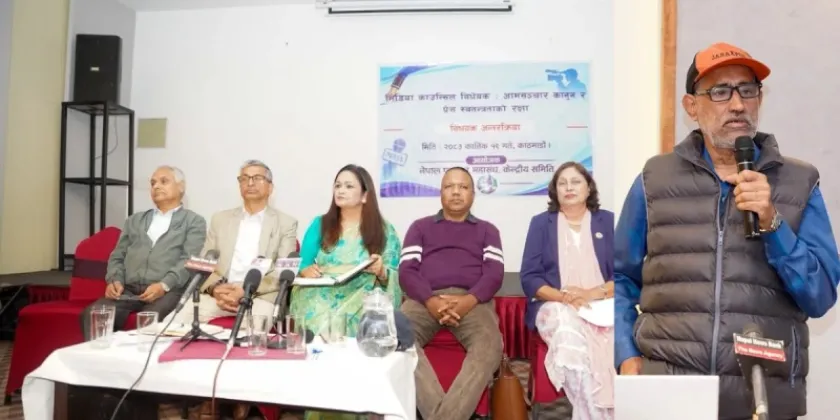
Dhrumendra Jha, senior journalist and former president of the Nepal Press Union, has warned that the Media Council ordinance increases the risk of the country's media being brought under control, describing the measure as a threat to press freedom. Jha, who also serves as chief editorial adviser of Nepal News Bank, made the remarks at a program organized by the Nepal Press Union central committee in Lalitpur on Thursday. His intervention places a prominent and experienced voice from within the journalism fraternity at the center of the discussion over the ordinance, and it reflects the concern now circulating within the media community about the direction of media regulation in Nepal.
Jha's Warning at the Lalitpur Program
Speaking at the Lalitpur gathering, Jha said the ordinance raises the risk of controlling the media, and he tied that risk directly to the future of press freedom in Nepal. According to reports published by Pradesh Khabar and Nepal Samaya, his warning to the program centered on two connected dangers:
- The risk of media control: Jha said the ordinance increases the risk of the media being controlled, a concern that speaks to the independence journalism requires in order to hold power to account.
- A threat to press freedom: He cautioned that the ordinance threatens press freedom, framing the issue as one that affects the entire media sector rather than any individual outlet.
Taken together, the two points form a clear position: a regulatory instrument that can be used to influence or discipline the press, in the view of senior journalists such as Jha, stands in tension with the democratic value of a free and independent media. By choosing a public program to deliver the warning, Jha ensured that the concern was voiced not in private consultation but before an audience of fellow journalists and union members.
The Weight Behind the Speaker
Jha's remarks carry significance not only for what he said but for who said it. As a former president of the Nepal Press Union, he remains closely associated with one of the organizations representing journalists across the country, and his current role as chief editorial adviser of Nepal News Bank keeps him active in the day-to-day practice of news journalism. When a journalist of this standing warns that a legal measure risks controlling the media, the observation is likely to be read within the sector as coming from experience rather than partisanship.
Press unions and professional associations play a central role in Nepal's media ecosystem. They provide journalists with collective representation, organize forums where policy and legal developments are debated, and act as watchdogs over proposals that could affect editorial independence. The Nepal Press Union's decision to convene a program addressing the Media Council ordinance, and to feature Jha as a speaker, reflects that watchdog function in practice. It also signals to policymakers that the profession is paying close attention to how the ordinance is framed and what powers it would place in the hands of a statutory body.
The Media Council and the Question of Control
Media councils exist in many countries as statutory bodies concerned with the conduct and standards of the press. The concerns that journalists typically raise about such institutions relate to their mandate, their composition and the scope of their powers: who appoints the members, what authority they hold over newspapers, journalists and digital outlets, and what safeguards exist if that authority is used to pressure critical reporting. Warnings of the kind Jha issued in Lalitpur belong to that wider conversation about whether statutory oversight of the media strengthens professional standards or erodes editorial independence.
Press freedom occupies a foundational place in Nepal's democratic framework, and the country's diverse media sector, which spans print, broadcast and digital platforms, has developed alongside a long history of advocacy for journalists' rights. Against that backdrop, proposals that would alter how the media is regulated are examined closely by the profession itself, and the language of control, the very language Jha used on Thursday, carries particular resonance within that debate.
A Union Forum and What Comes Next
The event in Lalitpur was organized by the central committee of the Nepal Press Union, the same body that Jha once led as president. Programs of this kind serve a dual purpose for journalists' organizations: they give members an opportunity to hear senior voices assess current legal and policy developments, and they allow the organizations to articulate positions on behalf of their membership. Thursday's program placed the Media Council ordinance at the heart of that conversation, and the message that emerged from Jha's address was one of clear concern about where the ordinance could lead.
Jha's warning signals that the ordinance is likely to remain under scrutiny from within the journalism sector as the debate over media regulation continues. For defenders of press freedom, the remarks underline the core demand that any regulatory framework preserve the independence of the press rather than narrow it. And for the Nepal Press Union, the Lalitpur program has served as a public statement that senior figures in the profession remain alert to any legal instrument that, in their assessment, could tighten control over Nepal's media.