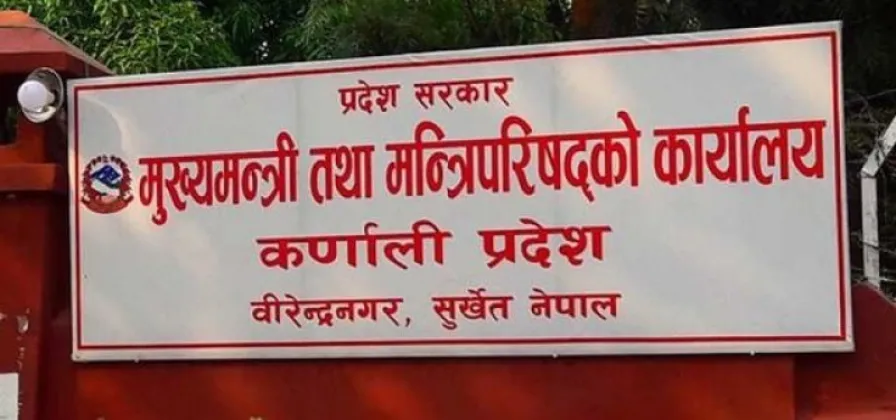
Karnali Province recorded an economic growth rate of 2.94 percent in fiscal year 2082/83, according to a study conducted by Nepal Rastra Bank. The figure, reported by Khabarhub, places the province well below the national growth projection of 3.89 percent for the same period and highlights the persistent economic distance between Karnali and the rest of the country. The study also shows that Karnali contributes just 4.20 percent of Nepal's total national economy, the smallest share among the country's seven provinces.
Growth Trails the National Projection
The 2.94 percent growth achieved by Karnali falls 0.95 percentage points short of the 3.89 percent national projection presented in the Nepal Rastra Bank study. A positive growth rate indicates that economic activity in the province expanded during the year, but the shortfall against the national benchmark shows that the pace of expansion was slower than the economy-wide average.
Provincial growth figures are typically read against the national rate to assess how evenly growth is spread across the federation. Judged on that measure, Karnali's performance in FY 2082/83 confirms its position at the lower end of the table. The size of the gap matters as much as the growth number itself, because a province that grows below the national average loses ground in relative terms even while its own economy keeps expanding.
The findings give both federal and provincial authorities a common baseline for evaluating the year's economic outcomes. With the national projection set at 3.89 percent, the study provides a clear yardstick against which each province's trajectory can be measured in the years ahead.
Key figures at a glance
- Karnali's growth rate: 2.94 percent in FY 2082/83
- National growth projection: 3.89 percent
- Shortfall against the national projection: 0.95 percentage points
- Karnali's share of the national economy: 4.20 percent, the smallest among seven provinces
- Far-Western region's growth: 3.28 percent in the same fiscal year
The Smallest Share of the National Economy
Perhaps the most consequential finding in the study is Karnali's 4.20 percent share of the national economy. Because the seven provinces together constitute the national economy, this share measures the province's economic weight relative to every other province. At 4.20 percent, Karnali holds the smallest slice of the national pie, meaning each of the remaining six provinces contributes a larger portion than Karnali does.
A share of this size points to a narrow economic base compared with the rest of the country. For Karnali, the figure underlines why its 2.94 percent growth, however positive in isolation, translates into only a modest addition to national output. The two findings together, a below-average growth rate and the smallest share of the national economy, capture the province's double disadvantage: it starts from the smallest base and is expanding more slowly than the national average.
A Regional Benchmark in the Far-West
The same fiscal year offers a useful point of comparison in the neighbouring province. According to a report by Ratopati, the Far-Western region's economic growth was recorded at 3.28 percent in FY 2082/83. That rate, while still below the national projection of 3.89 percent, is 0.34 percentage points higher than Karnali's figure, placing the Far-West closer to the national pace than Karnali in the year under review.
The side-by-side numbers underline the uneven geography of growth in Nepal's western provinces. Both provinces grew, but neither matched the national projection, and the gap between them shows that even among slower-growing provinces, performance can vary meaningfully from one fiscal year to the next.
Capital Expenditure and Employment Emerge as Core Challenges
The Ratopati report identifies capital expenditure and employment as the main challenges behind the region's modest growth performance. The pairing is significant for provinces in a similar position. Capital spending builds the infrastructure and productive capacity an economy needs to expand, while employment determines how far the benefits of growth reach households and local markets.
Where capital expenditure remains weak, projects that could lift output are delayed or scaled back, and where employment opportunities are scarce, household incomes and consumption stay constrained. Together, these constraints help explain why provinces in the western belt have struggled to keep pace with the national growth projection, even in a year when their economies continued to grow in absolute terms.
What the Numbers Signal
Taken together, the Nepal Rastra Bank study paints a picture of uneven growth across the country. Karnali's 2.94 percent growth and 4.20 percent share of the national economy leave it at the bottom on both counts among the seven provinces, while the Far-West's 3.28 percent growth, though stronger, also fell short of the 3.89 percent national projection.
The figures serve as a benchmark for the period ahead. If future studies show Karnali closing the distance to the national projection and its share of the national economy edging upward, that would point to a more balanced national economy. For now, the study documents with precision the distance that remains to be covered, both in the pace of Karnali's growth and in the size of the economic base behind it.