
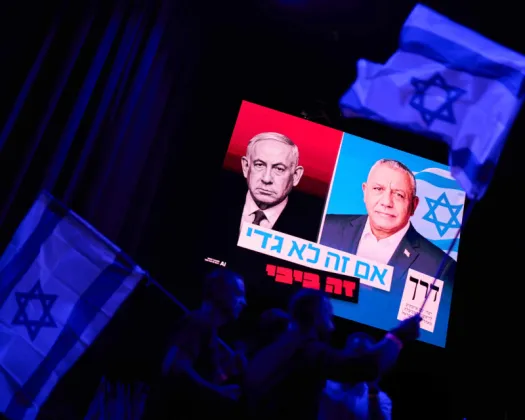
Israel's parliamentary election for the Knesset has ended with vote counting nearly complete and no political bloc on course for a clear majority, leaving the composition of the country's next government wide open. Prime Minister Benjamin Netanyahu's party is leading the field, while exit polls indicated that the alliance headed by opposition leader Gadi Eisenkot had won the most seats, though also short of the threshold needed to govern. With both rival camps declaring that they can form the next government, and debate continuing over the possible routes to a coalition, Israel has again been plunged into uncertainty over who will lead the country after a fractured national vote.
A Verdict Without a Majority
Signs of a hung verdict had emerged as counting neared completion, with no coalition able to point to a decisive parliamentary majority, as Nepal Press reported. Netanyahu's party finished ahead of all others, confirming its position as the strongest single force in the election. At the same time, exit polls pointed to a more nuanced picture: the bloc rallied around opposition leader Gadi Eisenkot was projected to have won the most seats collectively, even though that haul was not enough to form a government on its own.
The distance between those two findings, the largest single party versus the largest alliance, underscores how fragmented the result is. Neither Netanyahu's party nor the Eisenkot-led alliance can, on its own, command a majority in the Knesset, Israel's parliament. That arithmetic means the decisive factor in government formation will not be who finished first, but who can assemble enough coalition partners to cross the majority line.
Vote counting was still being finalized at the time of reporting, meaning the precise seat distribution had yet to be formally confirmed. As RatoPati noted, the signs of no clear majority have created uncertainty over government formation, a phrase that captures the mood in a country accustomed to hard-fought coalition bargaining.
Two Camps, One Claim
Both rival camps have claimed they can form the next government, a familiar assertion in Israeli politics but one that carries real weight when the result is this finely balanced. Netanyahu's camp can argue that the prime minister's party finished ahead of every other list, giving it the strongest claim to attempt coalition-building first. The Eisenkot camp, for its part, can point to exit polls suggesting its alliance won the most seats of any bloc, and insist that the momentum lies with the opposition.
Neither claim is decisive by itself. In a parliament where no single party has ever held an outright majority, the ability to govern depends on persuading smaller parties to join a ruling coalition, and those prospective partners typically weigh their options carefully before committing. The ongoing debate over the possible options for forming a coalition reflects exactly that reality, as each side assesses which combination of allies is most achievable and what concessions might be required to bring them on board.
The Politics of Coalition
The outcome is in many ways the latest installment of a familiar story. Israel has never seen a single party win an outright majority in a parliamentary election, and every government in the country's history has been formed through coalitions. That structural feature of Israeli politics means that election night rarely settles the question of who governs, and that the post-election period of negotiation is often as consequential as the campaign itself.
This election reinforces the pattern. Because neither bloc reached a majority, the next government will again emerge from bargaining, and the smaller parties that tip the balance will play an outsized role in shaping its composition and agenda. Coverage of the result, including by BBC Nepali, has highlighted the suspense surrounding the government formation process as the final votes are tallied and the parties position themselves for the talks ahead.
What Comes Next
Attention now turns from the ballot count to the negotiating table. The immediate questions facing Israel include:
- Whether Netanyahu, whose party leads the count, can convert a first-place finish into a workable governing coalition.
- Whether the Eisenkot-led alliance, projected by exit polls to hold the most seats, can assemble the partners it needs despite falling short of a majority.
- How the final confirmed results compare with the exit polls, and whether the emerging picture shifts once counting is formally completed.
- Which smaller parties emerge as the decisive players in coalition negotiations.
For now, the only certainty is uncertainty. With no clear majority for either bloc, both sides claiming the right to govern, and the coalition arithmetic still unresolved, Israel's next government will be decided not at the ballot box but in the negotiations that follow, in a country where coalition politics has always been the price of parliamentary democracy.


