
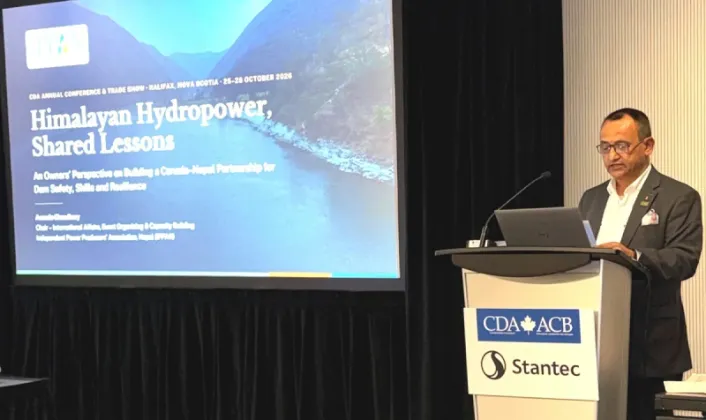
Mohan Kumar Dangi, chairperson of the Independent Power Producers' Association, Nepal (IPPAN), has called on the international community, including Canada, to invest in and share technology for reservoir-based hydropower projects in Nepal. Dangi made the appeal while addressing the 2026 annual conference and trade show of the Canada Dam Association in Canada, taking Nepal's private power sector message directly to an international gathering of dam professionals. His remarks, reported by RatoPati, Gorkhapatra Online and Global Aawaj, highlight the growing effort by Nepal's independent power producers to attract foreign capital and technical expertise for the country's next phase of hydropower development.
Dangi's Appeal at the Canada Dam Association Conference
Addressing the conference and trade show, Dangi urged international investors and technology partners to look toward Nepal's reservoir hydropower projects, with Canada singled out as a key potential partner. The setting was significant: the Canada Dam Association's annual conference and trade show brings together professionals involved in dam engineering, construction and management, making it a natural venue for a pitch that combines investment promotion with a request for technical cooperation.
Dangi's message to the gathering centered on two complementary needs for Nepal's hydropower sector:
-
Investment: Mobilizing international capital, including from Canada, for the development of reservoir-type hydropower projects in Nepal.
-
Technology sharing: Encouraging international partners to share dam-related technology and expertise so that Nepali projects can benefit from global experience in planning, building and operating large dams.
A Platform for Nepal's Power Producers
By speaking at a Canadian dam-sector event rather than confining his advocacy to Kathmandu, the IPPAN chair signaled that Nepal's private power industry is looking outward for partnerships. The appeal placed reservoir projects, rather than hydropower development in general, at the heart of the pitch, underscoring their particular importance in the country's energy conversation.
Why Reservoir Projects Are a Priority for Nepal
Reservoir-based hydropower projects store water behind a dam and release it as needed, in contrast to run-of-river projects, which generate electricity based on the natural flow of a river. This storage element is generally what makes reservoir projects attractive to countries seeking a reliable electricity supply, as generation can be adjusted across seasons and hours of the day rather than fluctuating with river flows alone.
For Nepal, the focus on reservoir projects carries particular weight. The country's hydropower portfolio has traditionally leaned toward run-of-river schemes, which are typically cheaper and quicker to build but whose output can vary significantly between the wet and dry seasons. Reservoir projects, while generally more capital-intensive and complex to develop, are widely viewed as essential for strengthening year-round power supply and giving the electricity system greater flexibility.
That combination of higher costs and technical complexity helps explain the shape of Dangi's appeal. By seeking both investment and technology sharing from international partners, the IPPAN chair pointed to the two ingredients that reservoir projects typically demand in large measure: substantial long-term financing, and specialized dam engineering and construction know-how that international firms, including those in Canada, have accumulated over decades.
IPPAN's Role in Nepal's Private Power Sector
In his address, Dangi also used the international stage to outline the credentials of the organization he leads. IPPAN, established in 2001, has worked continuously to promote private investment and hydropower development in Nepal's energy sector, the IPPAN chair told the conference.
As the association of Nepal's independent power producers, IPPAN has positioned itself as a key voice of the private sector in the country's energy development. Its self-described continuity of work since 2001 reflects more than two decades of engagement in promoting the role of private investment in a sector that has been central to Nepal's broader development ambitions.
Dangi's decision to carry that message to a Canadian audience also illustrates how the association's advocacy now extends beyond domestic policy. By presenting IPPAN's track record to an international room of dam specialists and potential investors, the chair sought to build confidence that Nepal's private power sector has the institutional experience to work with foreign partners on large, technically demanding projects.
Building Bridges Between Nepal and Canada
The appeal to Canada, in particular, points to an effort to broaden the range of international partners engaged in Nepal's hydropower development. Directly inviting Canadian and other international players to invest in and share technology for reservoir projects frames cooperation as a two-way exchange: foreign capital and expertise flow into Nepali projects, while partners gain a stake in the country's expanding energy sector.
The emphasis on technology transfer alongside investment is notable. Rather than seeking financing alone, Dangi's address to the Canada Dam Association conference presented technology sharing as an equal pillar of the proposed partnership, suggesting an interest in building durable technical capacity within Nepal's hydropower industry over the long term.
For now, the message delivered in Canada was unambiguous. Nepal's reservoir hydropower ambitions, as championed by IPPAN and its chair, require both money and know-how from abroad, and the international community, Canada included, has been formally invited to provide them. How that invitation is received by investors and dam technology firms following the 2026 conference will help shape the next chapter of Nepal's private-sector-led hydropower push.


