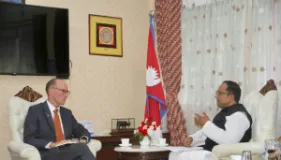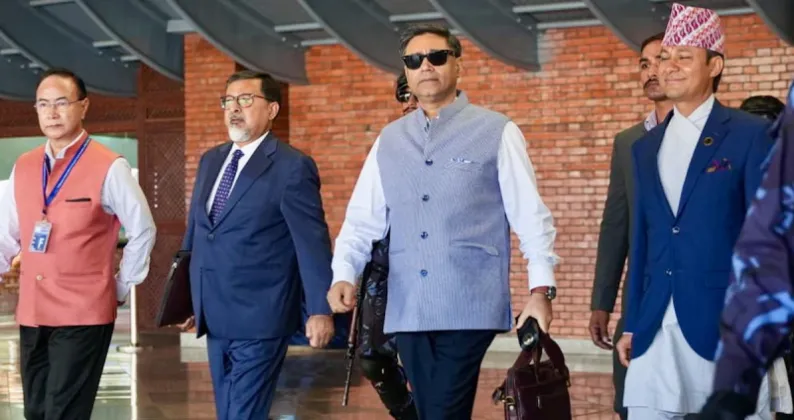
Indian Foreign Secretary Misri met with Nepal's Prime Minister Balen Shah in Kathmandu on Wednesday, in a senior-level diplomatic engagement that was as brief as it was closely noted. According to reports from the Nepali capital, the visiting Indian diplomat returned home immediately after concluding his meeting with the Prime Minister, bringing his presence in Kathmandu to an end within the same day.
The meeting drew attention for the seniority of the visitor and for the speed with which the visit was completed. Initial accounts from Nepali media focused on the core news of the engagement: that the head of India's diplomatic service had called on the Prime Minister and, once the meeting was over, was on his way back to India.
Meeting Held in Kathmandu on Wednesday
The meeting between Indian Foreign Secretary Misri and Prime Minister Balen Shah took place on Wednesday, according to reports from Kathmandu. Thahakahabar reported that Misri was returning home after the meeting with the Prime Minister, while Nepal Lead also covered the engagement, confirming the same basic sequence of events.
Based on the available reporting, the confirmed elements of the visit are as follows:
- Indian Foreign Secretary Misri met Prime Minister Balen Shah on Wednesday.
- The meeting was held in Kathmandu, Nepal's capital.
- Misri was returning home after the meeting with the Prime Minister concluded.
- The engagement was reported by Nepali news outlets, including Thahakahabar and Nepal Lead.
A Same-Day Visit
The reporting indicates a compact, single-day programme: the Foreign Secretary traveled to Kathmandu, held his meeting with Prime Minister Shah, and departed for home afterward. No additional engagements, calls or public appearances were mentioned in the initial accounts, and neither report described any event held alongside the bilateral meeting.
The Senior-most Diplomat in India's Foreign Policy
The foreign secretary occupies the highest post in India's Ministry of External Affairs and serves as the professional head of the Indian Foreign Service. In that capacity, the foreign secretary is deeply involved in shaping, coordinating and executing New Delhi's foreign policy, with the country's immediate neighborhood traditionally counted among the most sensitive and closely watched areas of Indian diplomacy.
Because of the seniority attached to the office, a visit by an Indian foreign secretary is generally regarded as a marker of the importance a country holds in New Delhi's diplomatic calculations. Such visits place the visiting official across the table from the host nation's top leadership, allowing for direct, high-level conversation without the formal weight of a head-of-state trip.
A Relationship Built on Regular High-Level Contact
India and Nepal share one of the closest relationships between any two neighboring countries, anchored in an open border, deep people-to-people ties and extensive day-to-day contact across a wide range of fields. Successive governments in both New Delhi and Kathmandu have maintained a steady rhythm of exchanges at political and diplomatic levels, making visits by senior Indian officials a familiar feature of the bilateral calendar.
Set against that pattern, Wednesday's meeting between Misri and Prime Minister Shah fits the established format of senior-level dialogue between the two capitals, in which the visiting side meets the host country's top leadership before returning home. Kathmandu, as the seat of Nepal's government, is the natural stage for such engagements, and meetings between visiting foreign secretaries and Nepali prime ministers have long served as a channel for the two sides to take stock of their relationship directly.
Why Engagements Like This Draw Attention
Meetings of this kind are watched closely in both countries for a simple reason: they keep the line of communication between the two governments open at the very top of the diplomatic hierarchy. Even when a visit is short and its programme limited, the act of meeting the head of government carries significance, signaling continuity in the relationship and a willingness on both sides to engage face to face.
What the Initial Reports Leave Open
While the fact, the day and the location of the meeting are firmly established, the initial reporting carried few particulars beyond them. The specific subjects raised in the conversation, any outcomes that may have emerged, and the precise duration of the talks were not detailed in the accounts published on Wednesday. The reports centered instead on the central news: that the Indian foreign secretary had met the Prime Minister and was returning home when the meeting ended.
That leaves several standard questions unanswered for the time being, including:
- Which bilateral, regional or other subjects featured in the discussion.
- Whether the Foreign Secretary's Kathmandu programme included any other calls or engagements beyond the meeting with Prime Minister Shah.
- Whether either government will issue a fuller readout of the conversation in the days ahead.
For now, the confirmed outline of the engagement is straightforward. An Indian foreign secretary traveled to Nepal, met Prime Minister Balen Shah in Kathmandu on Wednesday, and returned home once the meeting was done. Should either government release additional details about the discussion, they are expected to round out the picture of what was said at the Wednesday meeting in the Nepali capital.