
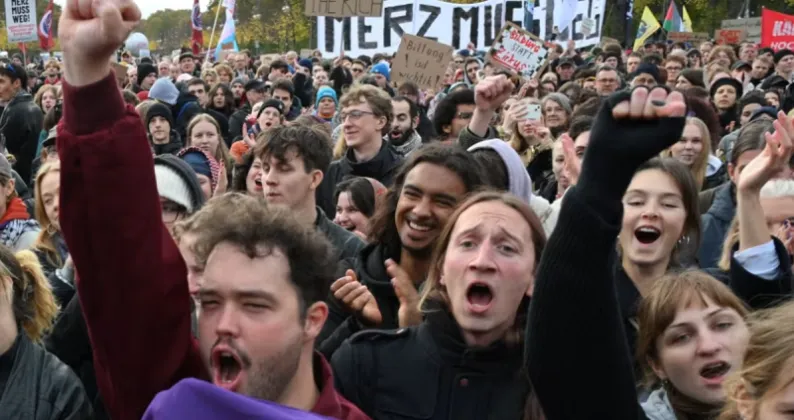
Gen Z protesters took to the streets in 34 cities across Germany in a wave of youth-led demonstrations reported by Nepali media on November 1, 2026, according to reports published by the outlets Thaha Khabar and Baahrakhari. The reports linked the movement to diaspora and cultural themes as well as to sport, but did not provide details on the organisers' demands, leaving both the immediate trigger and the specific goals of the protests unclear. Even so, the coverage stood out for the scale it described: action in dozens of German cities under a single youth-focused banner, a geographic spread that few protest campaigns achieve in any country.
A protest map spanning 34 cities
Both Nepali outlets reported that young people identified with the Gen Z label staged protests across 34 German cities. Neither report listed the individual cities, nor did they offer a breakdown of turnout by location, so it remains unknown whether the demonstrations ranged from large rallies in major urban centres to smaller gatherings in provincial towns. Germany's largest cities, including Berlin, Munich, Hamburg and Cologne, are traditionally the focal points for street protest in the country, although the available reports do not confirm which locations took part.
A 34-city footprint is notable by any measure. Germany has a well-established protest culture, and public assemblies enjoy strong constitutional protection, with authorities generally requiring advance notification rather than permission. That framework allows movements to scale up quickly across regions, but the reports available so far do not say whether the protests were coordinated centrally or grew out of local initiatives that shared a common banner.
Diaspora, culture and sport in the frame
The most distinctive element of the reporting is its thematic link. According to Thaha Khabar, the movement is tied to diaspora and cultural themes as well as to sport. Germany is home to one of Europe's largest migrant populations: more than 20 million residents have a family history of migration, and communities with roots in Turkey, Poland, Syria, Italy and elsewhere have long shaped the country's cultural and public life. The Nepali community in Germany, made up largely of students and workers, has also grown steadily in recent years, which gives the story particular resonance for Nepali readers.
The reports did not specify which diaspora communities were involved, what cultural questions were at stake, or how sport figured into the mobilisation. Without those details, the precise character of the protests, whether they were rallies for cultural visibility, demonstrations connected to a sporting occasion, or a broader identity-focused campaign, cannot be established from the available reporting.
Key questions left unanswered
Beyond the headline facts, the coverage left most questions open. Among the points not addressed in the reports:
- The organisers' demands, which were explicitly not detailed in the reporting
- The total number of participants and the turnout in individual cities
- The names of any organisations, spokespeople or coordinating groups
- Whether the protests remained peaceful or led to clashes, arrests or injuries
- Any reaction from German federal, state or city authorities
This portal could not independently verify the demonstrations beyond the two Nepali reports cited. The gaps matter for readers trying to weigh the significance of the events: multi-city mobilisation can signal serious organisational capacity, but without stated demands it is impossible to say what the movement is seeking, whether from policy makers, municipal authorities or public opinion at large. Should organisers come forward with a formal statement, that would likely clarify both their aims and the meaning of the diaspora, cultural and sporting themes attached to the action.
Part of a wider Gen Z moment
A name that now travels across borders
The Gen Z label has become a global shorthand in recent years for youth-led protest movements that organise rapidly through social media and often centre on governance, corruption and generational inequality. Since 2024, such movements have driven major political upheaval in several countries. Young protesters in Kenya forced the withdrawal of a contentious finance bill in 2024, student-led demonstrations in Bangladesh contributed to the fall of the Sheikh Hasina government the same year, and Nepal experienced its own Gen Z uprising in September 2025, which followed a deadly security crackdown and led to the resignation of the sitting prime minister and an interim government under former chief justice Sushila Karki. Comparable youth movements have also been seen in Indonesia, Morocco and Madagascar.
It was not clear from the available reports whether the German demonstrations are formally connected to any of those movements, share their organising methods or simply borrow the same name. What can be said is that the label now travels easily across borders, and that readers, particularly in Nepal, where the term carries immediate political weight, are likely to view the German protests against that global backdrop.
The story is developing. Further details on the organisers, their demands and any official response are expected to emerge as additional reporting becomes available, and updates will be carried as they are confirmed.


