
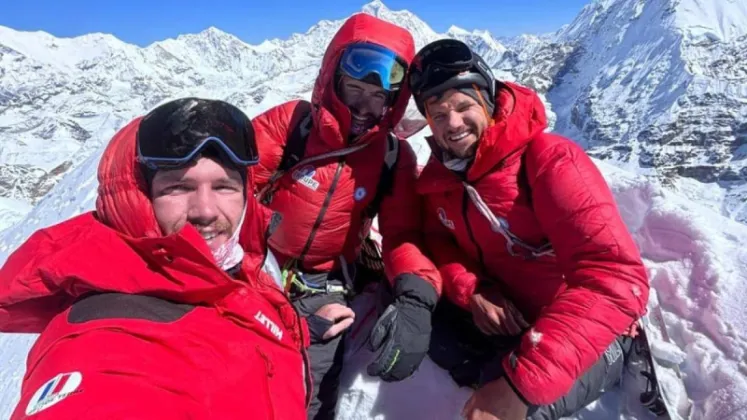
A three-member team from the French Army's high mountain specialists has opened a new route on the north face of Peak 41 (6,654 m) in Nepal, completing the climb on 14 October 2026 after four days of sustained effort on demanding technical terrain. The 1,400-metre line, named "Bon Matin", was climbed in pure alpine style, without supplemental oxygen or fixed camps, according to a report by The Himalayan Times.
The ascent was carried out by Sergeant Piontek, Corporal Fouillade and Corporal Paulin, all members of the French Military High Mountain Group (GMHM), the French Army's mountain unit based in Chamonix.
A Four-Day Push on the North Face
The team spent four days on the wall, working its way up roughly 1,400 vertical metres of technical climbing on the north face of Peak 41. By completing the route without oxygen, fixed camps or support infrastructure, the climbers joined a tradition of Himalayan ascents that place the burden of difficulty squarely on the climbers themselves, from the base of the face to the summit.
North faces rank among the most coveted objectives in mountaineering. Their steepness, cold and sheltered conditions typically demand sustained technical climbing at altitude, and opening a new line on such terrain, rather than following an existing path, is considered one of the sport's highest achievements.
Key facts at a glance
- Peak: Peak 41, 6,654 metres, Nepal
- Route: New line on the north face, approximately 1,400 metres
- Route name: "Bon Matin", French for "Good Morning"
- Team: Sergeant Piontek, Corporal Fouillade and Corporal Paulin of the GMHM
- Style: Alpine style, without supplemental oxygen or fixed camps
- Duration: Four days of climbing on technical terrain
- Completion date: 14 October 2026
The Climbers Behind the Ascent
The three climbers belong to the GMHM, the French Army's high mountain group headquartered in Chamonix, in the heart of the French Alps. The unit specialises in military operations and training in high mountain environments, and its members are among the most experienced alpinists available to the French armed forces.
The ranks of the three climbers, a sergeant and two corporals, reflect the unit's military character. Operating as a compact three-member team on a 6,654-metre peak also underscores the autonomy that defines the group's approach: with no larger expedition structure behind them, the climbers relied on their own skill, judgement and endurance throughout the four days on the face.
Chamonix, which sits beneath Mont Blanc, has long been one of the world's centres of alpinism, and the town's mountaineering culture is closely tied to France's military mountain units. The GMHM's latest Himalayan success adds to that lineage, bringing hard alpine climbing from the Alps to the high peaks of Nepal.
Alpine Style and Why It Matters
Alpine style, the method used on "Bon Matin", is widely regarded as the purest form of big-mountain climbing. In contrast to expedition style, which often involves staged camps, stocked routes and repeated carries of equipment, alpine-style climbers move continuously from the bottom to the top, carrying everything they need on their backs.
The defining features of the style include:
- No supplemental oxygen, meaning climbers operate on the thin air of altitude throughout
- No fixed camps above the start of the route, so no sheltered refuge partway up the face
- A continuous push, in which the team must commit to the climb until it reaches the top or retreats
- Minimal equipment, with every item carried by the climbers themselves
Applying this approach to a brand-new route multiplies the challenge. A first ascent offers no known conditions, no established belay points and no guarantee of a safe line, and on a 1,400-metre face of technical terrain, the team had to solve these problems while already deep in the climb. Four days of such climbing, at an altitude approaching 6,700 metres, represents a significant physical and mental commitment.
A New Line in Nepal's Autumn Season
The climb was completed in mid-October, a period that falls within Nepal's post-monsoon autumn season. This window is prized by mountaineers because weather patterns after the monsoon can offer more stable conditions than other times of year, drawing climbing teams to the country's high peaks.
Nepal's Himalaya remain a global stage for mountaineering, and the opening of new routes contributes to the country's rich climbing record. While much of the public attention on Nepali peaks centres on the highest summits, ascents of the kind completed on Peak 41 highlight another dimension of Himalayan climbing: the exploration of unclimbed faces and the technical lines that link them.
For Peak 41, the four-day effort by the GMHM team now has a permanent marker. The name "Bon Matin", meaning "Good Morning" in French, has entered the mountain's history, documenting a 1,400-metre route on its north face that was climbed on its own terms: no oxygen, no fixed camps and no shortcuts, only three climbers, four days and a new line to the top.
Additional details about the ascent are available in the original report by The Himalayan Times.


