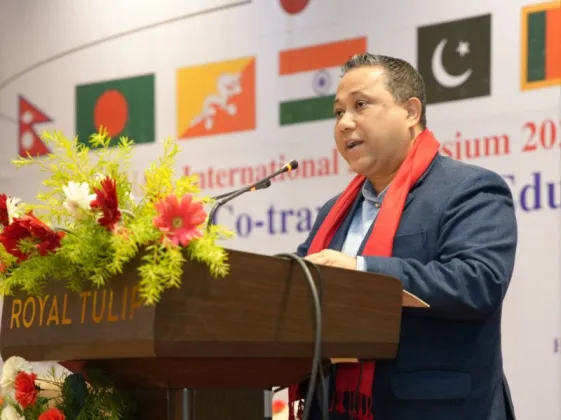
Foreign Minister Shishir Khanal said on Thursday that education, technology, innovation and people-to-people ties have further strengthened the historic friendship between Nepal and Japan, hailing Japan as Nepal's trusted development partner for the past seven decades. Addressing the opening session of the 'SAFJUA Symposium 2026' in Kathmandu as chief guest, Khanal argued that relationships built through educational exchange are the strongest and most durable bonds that can exist between two nations, a message that placed education at the very centre of the bilateral relationship.
Education and exchange at the heart of the relationship
Khanal told the gathering that the friendship between the two countries rests not only on formal diplomacy and development assistance, but equally on the flows of students, scholars and ideas that have connected Nepal and Japan for decades. Cooperation in education, technology and innovation, together with ever closer people-to-people contact, had given renewed strength to a relationship spanning more than seventy years, he said.
It was educational exchange, however, that the foreign minister singled out as uniquely powerful. Relations built through educational exchange, he noted, can be the strongest and most long-lasting between nations. His argument reflected a simple premise: students who study abroad return home carrying far more than a degree. They bring language skills, professional networks, familiarity with another society's ways of working, and often a lasting personal affection for the country that hosted them. In Nepal's case, the alumni of Japanese universities have become part of the connective tissue between the two societies, reinforcing official ties from the ground up.
Seven decades of Japanese partnership
Khanal reserved particular praise for Japan's role in Nepal's development, describing the country as a trusted development partner over the past seven decades. He highlighted the breadth of Japanese cooperation, which he said has extended across a wide range of sectors:
- Infrastructure, where Japanese support has helped lay the physical foundations of Nepal's economy and connectivity
- Education, strengthening learning opportunities and the skills of Nepali teachers and students
- Health, contributing to services and systems that reach communities across the country
- Agriculture, supporting productivity and rural livelihoods
- Disaster resilience, an area of clear importance for a country familiar with earthquakes, floods and landslides
- Human resource development, equipping Nepalis with the training and expertise needed to lead the country's development
Taken together, these strands of cooperation have left a visible imprint on Nepali society, and the minister presented them as evidence of a partnership that has proven itself over generations. In his telling, Japan's contribution has gone beyond individual projects: it has helped build the human and institutional capacity through which Nepal pursues its own development, and it has created the mutual goodwill on which deeper ties can now be constructed.
A Kathmandu stage for a regional alumni network
The symposium that provided the setting for Khanal's address was organised by the South Asia Federation of Japanese University Alumni Association (SAFJUA), a body that brings together alumni of Japanese universities from across the South Asian region. Its 2026 symposium opened in Kathmandu on Thursday, with the foreign minister attending the opening session as chief guest.
Gatherings of this kind serve a purpose that is easy to underestimate. Alumni associations keep academic relationships alive long after graduation, connecting former students of Japanese institutions across national borders and giving them a forum to share experiences, sustain professional links and encourage new generations to pursue study in Japan. Hosting the event in Kathmandu underscored the weight Nepal places on its educational relationship with Japan, and gave Nepali alumni a prominent platform within a wider regional network. The minister's presence at the opening session signalled the importance the government attaches to these grassroots channels of friendship.
People-to-people diplomacy in practice
Khanal's remarks placed people-to-people ties alongside technology and innovation as engines of the bilateral relationship, a framing that treats ordinary citizens, students, professionals and alumni as central actors in foreign policy rather than bystanders to it. In the Nepal-Japan context, that approach has a long runway: the seven decades of development partnership he invoked were themselves built, in part, by the Nepalis trained through Japanese cooperation and by the personal bonds formed along the way.
The address also carried a forward-looking note. By pairing a celebration of past cooperation with an emphasis on education, technology and innovation, the foreign minister pointed toward a relationship measured increasingly in human capital as much as in aid flows. For Nepal, with its youthful population and pressing need for skills, the implication was clear: the next chapter of the friendship with Japan will be written in classrooms, laboratories and alumni networks as much as in official agreements.
His remarks at the symposium were reported by Nepal Press, Ratopati and News of Nepal.