
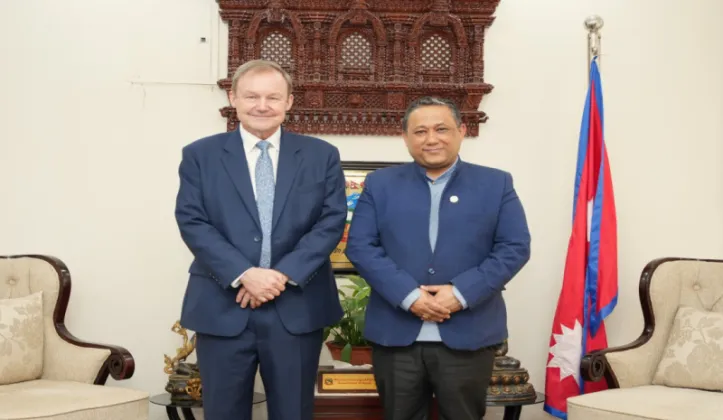
Kathmandu - Foreign Minister Shishir Khanal held a courtesy meeting with Rob Fen, the British Ambassador to Nepal, at the Ministry of Foreign Affairs in Singha Durbar, Kathmandu, on November 2, 2026. The conversation focused on the state of Nepal-United Kingdom relations and a range of issues of mutual interest, with climate change, climate finance and resilient economic development featuring prominently on the agenda. The meeting, reported by Gorkhapatra Online, reflects the continuing high-level engagement between Kathmandu and London.
Courtesy Call With a Substantive Agenda
According to the details available of the conversation, Minister Khanal and Ambassador Fen discussed the following areas:
- The overall state of Nepal-UK bilateral relations
- Matters of mutual interest between the two countries
- Climate change and the global response to it
- Climate finance for climate-vulnerable economies
- Resilient economic development
- United Nations structures related to climate change
Although arranged as a courtesy call, a format diplomats typically use to build rapport and take stock of ties, the breadth of the agenda indicated that both sides saw merit in a working-level exchange on policy issues. Courtesy meetings between a foreign minister and a resident ambassador often serve as an early opportunity to review cooperation, compare perspectives on international developments, and signal the importance each government attaches to the relationship.
A Long-Standing Bilateral Relationship
Nepal and the United Kingdom share one of the oldest diplomatic relationships in Nepal's foreign policy history. Formal ties between the two countries date back to the Treaty of Friendship of 1923, and London was among the first capitals where Nepal established a diplomatic presence. Over the decades, the relationship has spanned development cooperation, trade, education and people-to-people links, including the long tradition of Gurkha service in the British Army, which remains a distinctive thread connecting the two societies.
For the United Kingdom, Nepal is a partner in areas such as development cooperation and regional engagement, while for Nepal, Britain is a longstanding development partner and an important destination for trade, investment and higher education. Senior-level contacts of the kind held at Singha Durbar help sustain the rhythm of this relationship and provide a direct channel for raising both bilateral priorities and wider global questions.
Climate Change at the Center of Talks
A notable feature of the meeting was the emphasis placed on climate change. Nepal, home to much of the Himalayan range, is widely recognized as one of the countries most vulnerable to the impacts of a warming planet, including melting glaciers, shifting monsoon patterns and increasingly frequent extreme weather events that threaten agriculture, infrastructure and livelihoods. Successive governments in Kathmandu have consequently placed climate diplomacy at the heart of the country's foreign policy, using international forums to press the case of mountain nations.
Against this backdrop, the discussion on climate finance carried practical significance. Climate finance refers to the funding that helps developing countries reduce emissions and, just as importantly, adapt to impacts that can no longer be avoided. Questions of access, scale and fairness in these financial flows have been central to global climate negotiations, and climate-vulnerable nations such as Nepal have consistently sought stronger and more predictable support from developed economies.
The two sides also discussed resilient economic development, an approach that aims to build economies capable of withstanding climate shocks rather than merely absorbing them. For Nepal, resilience is closely tied to sectors such as agriculture, hydropower and tourism, all of which are exposed to climate risks, and to the country's long-awaited transition out of least developed country status, which makes the theme especially timely.
The Multilateral Dimension
The inclusion of United Nations structures related to climate change in the conversation pointed to the multilateral arena where both countries are active. The United Nations Framework Convention on Climate Change and its annual Conference of the Parties remain the principal platforms where climate finance commitments are negotiated and reviewed. Nepal has used such forums to highlight the fragility of mountain ecosystems and the disproportionate burden borne by countries that contribute little to global emissions, while the United Kingdom has positioned itself as a significant voice in international climate diplomacy, including through its hosting of the COP26 summit in Glasgow in 2021.
Continuity in Kathmandu-London Engagement
While the readout of the meeting was brief, exchanges of this kind typically help set the tone for more detailed engagements between the two governments, from cooperation programs to coordination in multilateral bodies. For the Ministry of Foreign Affairs, receiving a resident ambassador on a courtesy call is also a routine feature of diplomatic life in Kathmandu, where envoys regularly call on the foreign minister as part of ongoing consultations.
For now, the meeting underscored two constants in Nepal's external relations: the value Kathmandu places on its historic ties with the United Kingdom, and the centrality of climate change, climate finance and resilient development to the country's international agenda. As these themes remain permanent fixtures of global diplomacy, they are expected to continue shaping dialogue between Nepal and its partners, including Britain.


