
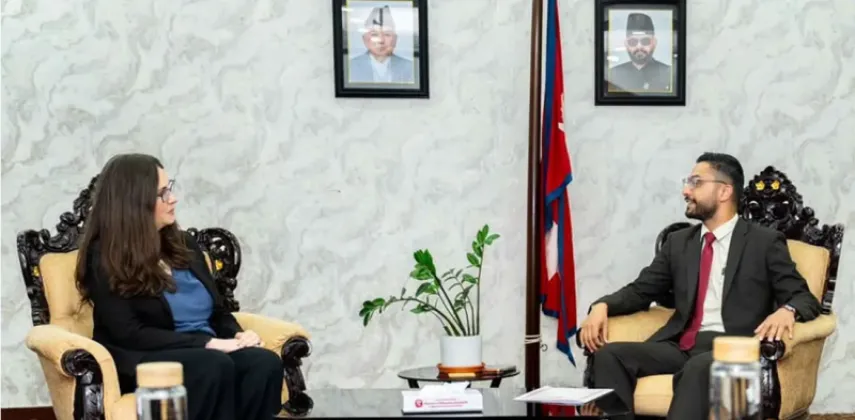
Education and Sports Minister Sasmit Pokharel held a courtesy meeting with the United States' Chargé d'Affaires to Nepal, Megan Bouldin, at the Ministry of Education and Sports in Kathmandu on Friday. The two sides discussed strengthening Nepal-US educational cooperation, advancing sports diplomacy and reviewing various aspects of the broader bilateral relationship. The meeting was confirmed in reports by Khabarhub and Ratopati.
Talks Focused on Education and Sports
The courtesy call placed the two sectors under Minister Pokharel's portfolio at the centre of the conversation. According to the reports, Pokharel and Bouldin exchanged views on ways to deepen cooperation between Nepal and the United States in the education sector, an area where both countries see room for closer engagement.
The discussion also turned to sports diplomacy, with the two officials exploring how sporting ties can serve as a bridge between nations. Because the ministry oversees both education and sports, the agenda reflected the full breadth of the portfolio that Pokharel manages.
The key themes that surfaced during the meeting were:
- Educational cooperation: strengthening collaboration between Nepal and the United States in the education sector
- Sports diplomacy: using sporting engagement to build goodwill and people-to-people connections
- Bilateral relations: reviewing various aspects of the wider Nepal-US relationship
The published reports did not disclose any agreements reached or programmes announced during the meeting, and no detailed joint statement has been issued so far.
The Diplomatic Weight of a Courtesy Meeting
In diplomatic practice, a courtesy meeting of this kind serves a clear purpose. It allows a senior envoy and a government minister to establish or renew direct lines of communication, exchange views on mutual priorities and signal interest in cooperation without the pressures of formal negotiations. Such encounters often open the door to more substantive sectoral dialogues at a later stage.
Bouldin's role gave the meeting particular weight. As chargé d'affaires, she heads the United States' diplomatic mission in Nepal in the absence of an ambassador, representing Washington in its day-to-day engagement with the government in Kathmandu. Her call on the minister responsible for education and sports signals that these sectors remain an active channel in the bilateral conversation.
For Pokharel, receiving the senior American diplomat at the ministry offered an opportunity to place Nepal's priorities in education and sports directly before the mission that steers US engagement in the country.
Education as a Longstanding Bridge
Education has long been among the most visible threads in Nepal-US relations. The United States is widely regarded as a leading destination for Nepali students pursuing higher studies abroad, and academic exchange continues to bind the two societies at the people-to-people level. It is against this backdrop that educational cooperation figured prominently in Friday's discussion.
Strengthening cooperation in the sector carries practical significance for Nepal. Students, teachers and institutions stand to benefit when academic ties run smoothly, and governments on both sides have an enduring interest in keeping those channels open. While the reports did not detail specific initiatives, the prominence the subject received in the meeting underlines the importance both sides attach to academic ties.
Sports Diplomacy: Soft Power Beyond the Field
Sports diplomacy has emerged in recent decades as a recognised instrument of statecraft. Governments use sporting exchanges, joint events and cooperation in athletic development to project goodwill, reach younger audiences and build cultural understanding that formal negotiations alone cannot always achieve. In that sense, sport operates as a form of soft power, creating connections between societies that persist well beyond any single match or tournament.
For Nepal, the emphasis fits naturally with the responsibilities of the Ministry of Education and Sports, which oversees the development of athletics alongside the country's education system. For the United States, engagement through sport offers an additional avenue of connection with the Nepali public, complementing the diplomatic and academic strands of the relationship. Friday's exchange suggests both sides see value in developing this dimension, even though concrete programmes were not disclosed in the initial reports.
Keeping the Broader Relationship in Motion
Beyond education and sports, the meeting also touched on various aspects of Nepal-US bilateral relations more broadly, the reports said. Nepal and the United States maintain long-standing diplomatic ties, and regular contact between ministers and senior envoys is a routine feature of that relationship. Courtesy calls such as Friday's help sustain the conversation, giving both sides a chance to take stock of priorities and identify areas of mutual interest.
No follow-up measures or specific outcomes were announced in the initial reports. Even so, the exchange stands as a clear sign of continued engagement between the two countries in the sectors that touch ordinary citizens most directly: the classroom and the playing field.


