
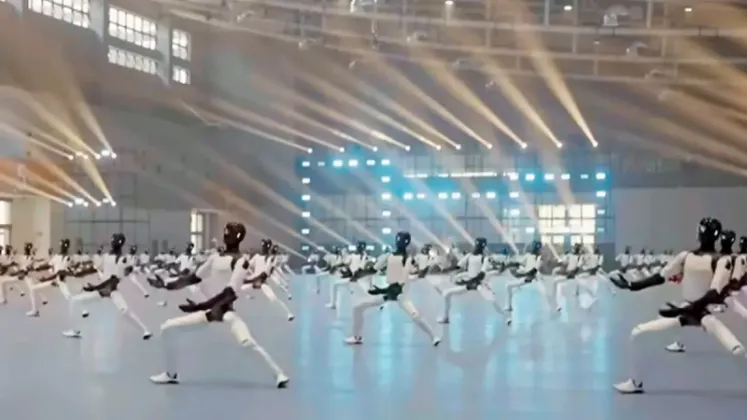
China has added a remarkable new entry to its list of technological achievements, with 110 humanoid robots performing a synchronized dance in Shandong province to secure a Guinness World Record. The robots, named AGBOT, moved in unison throughout the routine, their coordinated steps earning official recognition for the record-setting display. The feat marks a new milestone in China's technological progress and offers a vivid illustration of how far coordinated robotics has advanced, according to reports from Ratopati. What might once have sounded like science fiction, more than a hundred humanoid machines dancing together in perfect time, has now been formally certified as a world first.
A Choreographed Performance in Perfect Unison
The record attempt was built around a simple but exceptionally demanding premise: getting 110 separate humanoid robots to dance at the same time, with the same movements, at the same tempo. The AGBOT units carried out their choreographed routine simultaneously, and it was this synchronized execution that earned the Guinness World Record designation for China.
Synchronized dancing is widely regarded as one of the most visually striking ways to demonstrate robot coordination. Unlike a single robot performing alone, a group routine leaves no room for individual error. If one machine falls behind the beat or drifts out of position, the entire formation is compromised. That the AGBOT robots were able to complete the performance together is what set this achievement apart and made it record-worthy.
The choice of Shandong province as the venue added a domestic stage for the milestone. The performance was not merely a technical test carried out behind closed doors, but a public-facing spectacle designed to showcase what the machines can do, as highlighted in the original report.
Why Synchronized Movement Is So Difficult
Coordinated robot dancing might look effortless once achieved, but it places steep demands on the hardware and software behind it. Performances of this kind typically test several capabilities at once:
-
Balance and stability: Humanoid robots must remain upright while shifting weight, stepping and turning, all without the steadying support of a fixed base.
-
Timing: Every unit in the formation has to act on the same rhythm, since even a fraction of a second of delay can break the visual harmony of the group.
-
Coordination: With 110 robots sharing one stage, each machine must be aware of its position relative to the others so the overall formation holds its shape.
-
Consistency: A record attempt of this scale depends on every single robot performing reliably, because the synchronized count is only as strong as its weakest participant.
Meeting all of these requirements simultaneously, across more than a hundred machines, is precisely what made the Shandong performance notable enough for Guinness World Record recognition.
A Milestone in China's Technological Story
Beyond the spectacle itself, the record carries broader significance for China's technology sector. As the summary of the achievement notes, the feat marks a new milestone in the country's technological accomplishments. World records in robotics serve a purpose that goes beyond bragging rights: they provide an internationally recognized benchmark against which progress can be measured and publicized.
For China, the AGBOT performance represents a statement of capability in a field where humanoid robots have become a high-profile frontier. Demonstrations of large numbers of machines acting in concert communicate a level of maturity in design, manufacturing and control that individual prototypes cannot easily convey. A hundred and ten robots dancing together suggests systems that can be built at scale, deployed in formation and relied upon to perform consistently, qualities that matter far beyond the dance floor.
The record also reflects the growing role of public demonstrations in the robotics industry. Rather than confining its machines to laboratories, the team behind AGBOT presented them in a format accessible to a wide audience. Dance, with its universal appeal and clear standard of success, proved an effective medium for making complex engineering legible to the public.
Reading the Bigger Picture
While the Shandong event was, at its core, a Guinness World Record attempt, it sits within a larger moment for humanoid robotics. Machines that walk, balance and move with human-like form have moved steadily from research curiosities toward public showcases, and synchronized group performances represent one of the clearest ways to signal that transition. Each new benchmark, whether in numbers, precision or endurance, redraws the line of what is considered possible.
For now, the specific achievement stands on its own terms: 110 AGBOT humanoid robots, one choreographed routine, and a synchronized dance performed well enough to enter the Guinness World Records. The performance in Shandong has already secured its place in the record books, and it has given audiences around the world a memorable glimpse of a future in which machines move not just competently, but together.
As China continues to log milestones in robotics and related technologies, the AGBOT record offers a telling snapshot of the present state of the field, and a hint of the ambitions that lie ahead.


