
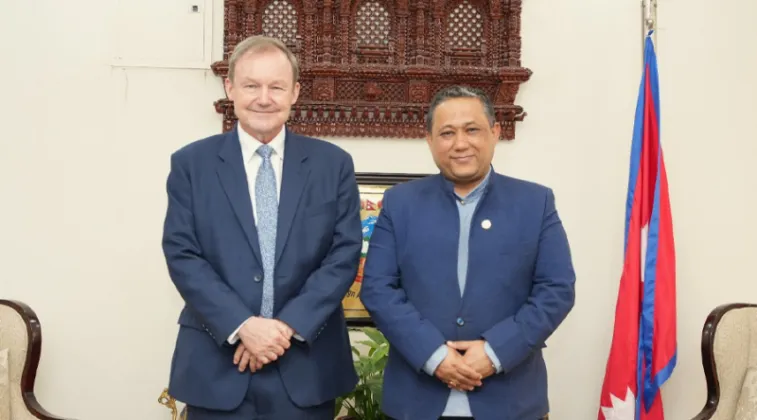
British Ambassador to Nepal Rob Fenn paid a courtesy call on Minister for Foreign Affairs Shisir Khanal at the Ministry of Foreign Affairs at Singha Durbar on Monday, with the two sides discussing the state of Nepal-United Kingdom relations and a series of issues of mutual interest. According to the Ministry of Foreign Affairs and the minister's secretariat, as reported by OnlineKhabar, the talks covered bilateral cooperation, climate finance, resilient growth and the upcoming COP31 climate conference.
A diplomatic touchpoint at Singha Durbar
The meeting took place at Singha Durbar, the historic palace complex in Kathmandu that today houses Nepal's principal government offices, including the Ministry of Foreign Affairs. Courtesy calls of this kind are a standard feature of diplomatic practice in Kathmandu, offering resident ambassadors a channel to establish direct contact with ministers, review ongoing cooperation and raise matters of concern. For Fenn, the call provided an opportunity to engage directly with the minister who leads Nepal's foreign policy at a time when the two countries continue to work together across a broad agenda.
In its readout, the ministry highlighted four themes that framed the conversation, spanning both the traditional pillars of the relationship and the global issues that increasingly shape diplomacy for climate-vulnerable countries such as Nepal:
- Bilateral cooperation, reflecting the breadth of ties between Kathmandu and London
- Climate finance, a long-standing priority for Nepal as a mountain country facing outsized climate impacts
- Resilient growth, linking economic partnership with the capacity to withstand shocks
- COP31, the next round of United Nations climate negotiations
The ministry did not elaborate on the specific points raised by either side, and neither the embassy nor the minister's secretariat released further details. The range of topics on the table, however, indicates that the conversation moved beyond protocol into substantive areas of cooperation, placing climate diplomacy and economic resilience at the centre of the exchange.
Climate finance and the mountain agenda
The prominence of climate finance in the readout is significant for Nepal. Although the country contributes a negligible share of global greenhouse gas emissions, it is widely regarded as one of the world's most climate-vulnerable states, with Himalayan glaciers retreating, weather patterns becoming increasingly erratic and natural disasters posing recurring risks to lives, infrastructure and livelihoods. Kathmandu has used successive international forums to argue that frontline countries need predictable and accessible financial support for adaptation and for addressing the loss and damage they suffer, and it has pressed developed economies to deliver on their climate finance commitments.
The road to COP31
COP31 refers to the 31st session of the Conference of the Parties to the United Nations Framework Convention on Climate Change, the annual summit at which governments negotiate collective action on emissions, adaptation and finance. As the next milestone in that process, it is expected to be a key venue for mountain and other climate-vulnerable nations to press their priorities. For Nepal, coordinating positions with partners such as the United Kingdom ahead of the negotiations carries practical weight, given Britain's active engagement in international climate finance mechanisms and its long-standing participation in the UN climate process.
The ministry's summary did not spell out how the two sides approached the climate agenda on Monday, but the pairing of climate finance with COP31 in the list of discussion points underlines how central the issue has become to Nepal's external engagement, now sitting alongside bilateral questions rather than apart from them.
Resilient growth and the economic dimension
The third theme singled out, resilient growth, points to the economic side of the relationship. In development vocabulary, resilient growth describes economies capable of absorbing and recovering from shocks, whether climate-related disasters, public health emergencies or turbulence in the global economy. For Nepal, which is preparing to graduate from least developed country status, building such resilience is closely tied to infrastructure, disaster preparedness, tourism, remittance flows and the diversification of an economy that remains exposed to external disruption.
The United Kingdom has been one of Nepal's long-standing development partners, and discussions of resilient growth between the two countries typically revolve around how cooperation can support investment, job creation and stronger institutions. The framing of resilient growth alongside climate finance in the ministry's readout reflects the way Kathmandu has increasingly presented its development and climate priorities as interconnected challenges on the international stage.
A relationship rooted in history
Monday's meeting comes against the backdrop of one of the oldest bilateral relationships in Nepal's diplomatic history. Nepal and the United Kingdom established formal diplomatic relations in 1934, making Britain the first country with which Nepal opened such ties, and the friendship reaches back further still, to the 1923 Treaty of Friendship and, before that, to generations of Gurkha service in the British Army.
In the present day, the relationship spans trade and investment, development cooperation, education, tourism and the people-to-people links sustained by a large Nepali community living in the United Kingdom. Regular high-level contact of the kind seen on Monday forms part of the rhythm through which the two governments take stock of this agenda and exchange views on regional and global developments of common concern.
Further details of the conversation were not immediately made public. The ministry's summary, however, makes clear that climate diplomacy and resilient development now stand alongside traditional bilateral matters at the heart of Nepal-UK discussions.


