
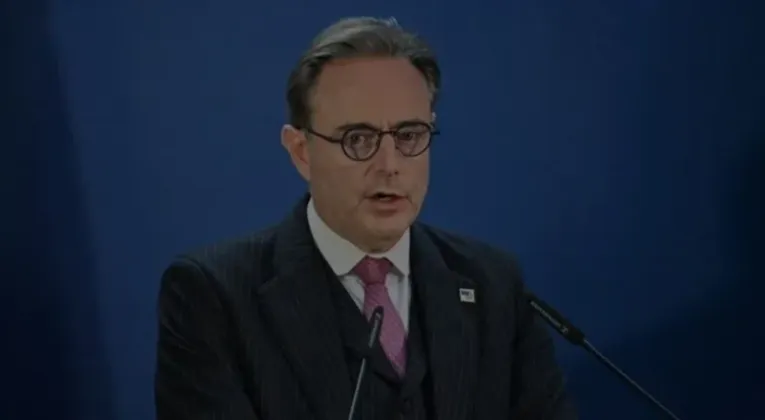
Belgian Prime Minister Bart De Wever has submitted his resignation to King Philippe after coalition negotiations aimed at agreeing next year's federal budget collapsed, plunging Belgium into another bout of political uncertainty. The resignation was handed over on Monday, but the monarch has said he will decide whether to accept it only after a new meeting on Friday, leaving the prime minister and his government in limbo for the rest of the week.
De Wever, a conservative Flemish nationalist who leads a five-party coalition, took the step after failing to secure support from his governing partners for a package of proposals designed to tackle Belgium's high budget deficit. According to reporting by Ratopati, the talks foundered over the scale and distribution of the savings, and the prime minister concluded he could no longer govern effectively without a budget agreement.
Budget Talks Collapse Inside a Fragile Coalition
The immediate trigger of the crisis was the breakdown of negotiations over the next federal budget. De Wever had pressed his coalition partners to back a series of cost-saving measures intended to put Belgium's public finances on a firmer footing. The centrepiece of the plan was an ambitious savings target of 10 billion euros, or about 11.6 billion US dollars, by 2029.
Despite prolonged bargaining, the five parties that make up the governing alliance could not bridge their differences over the proposals. Without backing from all of his coalition partners, De Wever could not count on a parliamentary majority for the package, and he chose to put his mandate on the line rather than preside over a budget his government could not deliver.
The key facts of the crisis are as follows:
- De Wever submitted his resignation to King Philippe on Monday, following the failure of coalition talks over next year's federal budget.
- The five-party coalition he leads proved unable to agree on the savings package.
- The plan aimed to save 10 billion euros (11.6 billion US dollars) by 2029 in order to reduce Belgium's high budget deficit.
- King Philippe will decide whether to accept the resignation only after a new meeting on Friday, keeping the government's fate open until then.
The King's Deliberate Pause
King Philippe's decision to defer judgment is a familiar ritual in Belgium's constitutional system, where the monarch's role in moments of governmental crisis is procedural but carefully choreographed. By waiting until Friday, the King keeps every option open: he can accept the resignation, which would set in motion consultations over a new government or potentially fresh elections, or he can refuse it, as Belgian monarchs have done in past crises, and send the prime minister and his ministers back to their desks.
In the meantime, De Wever and his government remain in office to handle the day-to-day running of the country. There is no automatic dissolution of parliament when a Belgian government tenders its resignation; instead, the executive continues to manage routine affairs until the head of state rules on the resignation and a way forward is found.
The pause also gives the coalition parties a window to reflect. With the budget dispute still unresolved, the days between now and Friday's meeting may determine whether the five-party alliance can be persuaded to return to the negotiating table, or whether Belgium is heading toward a longer period without a fully functioning government.
The Deficit Problem Behind the Breakdown
At the heart of the standoff lies Belgium's strained public finances. The country has been wrestling with a high budget deficit, and De Wever's proposed savings of 10 billion euros by 2029 were intended to bring spending back under control over the coming years. For the prime minister, himself a proponent of fiscal discipline, the target was the minimum needed to restore credibility to the national accounts.
But austerity on that scale is never easy to sell, particularly in a coalition that must hold together parties drawn from different political traditions and from both sides of Belgium's linguistic divide. Spending cuts and fiscal consolidation carry different consequences for different regions and different electorates, and each of the five governing parties faces its own voters and its own red lines. That arithmetic proved unforgiving: the failure to secure support for the deficit-reduction proposals left De Wever with no budget, and ultimately no government.
A Country Familiar With Political Deadlock
Belgians are no strangers to drawn-out political crises. The country's fragmented landscape, in which Dutch-speaking and French-speaking parties compete in separate electoral circuits and national governments must be stitched together from several of them, has repeatedly produced long and difficult formation talks. In the past, Belgium has gone many months without a fully empowered government while negotiations dragged on, and the coalition that brought De Wever to power earlier this year was itself the product of months of bargaining after national elections.
De Wever, who leads his party as its dominant figure and campaigned on a platform of firmer fiscal management, has now staked his premiership on the budget fight. Whether that gamble forces his partners to relent, or ends his government altogether, will become clearer after King Philippe's deliberations conclude.
For now, attention turns to the Royal Palace. Whatever the King decides on Friday, the underlying dispute over how to save 10 billion euros by 2029 remains unresolved, and with it the broader question of whether Belgium's five-party coalition can survive long enough to pass a budget at all.


