
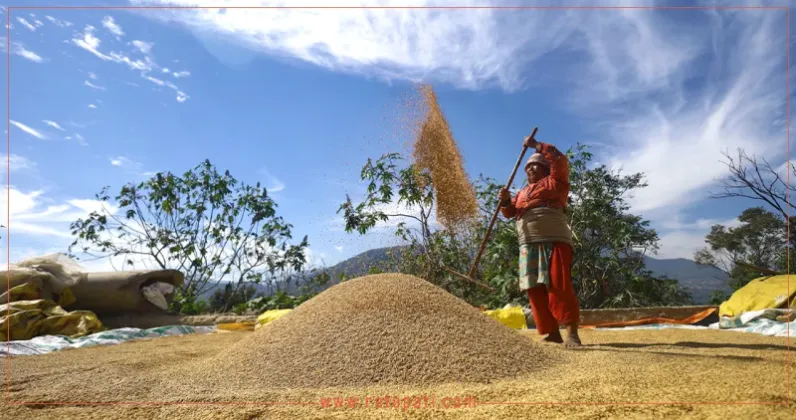
Farmers in Banke district are selling paddy to traders for Rs 500 to Rs 1,000 per quintal less than the government-fixed price as they seek money for Tihar and other upcoming festivals. The Food Management and Trading Company Limited has set this year’s rate at Rs 3,660 per quintal for coarse paddy and Rs 3,860 for medium paddy. But farmers say they cannot hold their harvest until the company begins buying because they lack adequate storage space, leaving traders to purchase the crop at lower rates.
Official prices and what farmers receive
The difference between the official rate and the prices being offered by traders is reducing the amount farmers receive for their harvest. Based on the reported gap, traders’ offers are roughly Rs 2,660 to Rs 3,160 per quintal for coarse paddy, and Rs 2,860 to Rs 3,360 for medium paddy. The exact amount depends on how far below the government rate a particular sale is made.
The government-fixed prices provide a benchmark for the two categories of paddy, but farmers in Banke say the benchmark does not help them if they cannot wait for the company’s purchasing process. Their immediate need for cash and lack of space to store harvested grain have put them in a position where they must consider the lower offers available from local traders.
For farmers selling at the reported discounts, the loss is calculated on every quintal. The difference of Rs 500 to Rs 1,000 can therefore become substantial across a harvest, although the amount each farmer loses depends on the quantity sold and the price received. The available information does not specify how much paddy individual farmers have sold or the total volume traded in the district.
Storage constraints and festival expenses
Farmer Dhruva Thapa of Nepalgunj-19 Suiyagau said this year’s harvest was good. However, he said farmers do not have the storage facilities needed to keep their paddy until the Food Management and Trading Company begins purchasing. The challenge, therefore, is not simply the size of the crop: farmers also need somewhere to keep it while they wait for a buyer offering the official rate.
The timing adds pressure. With Tihar and other festivals approaching, farmers need money to meet expenses and are selling their produce rather than holding it. A good harvest has not prevented them from accepting lower prices when cash is needed and storage is unavailable. Traders are buying at rates below the official level, and farmers bear the resulting difference.
The reported situation highlights the gap between a government-set purchase price and the price farmers can secure when they need to sell immediately. For growers who are unable to store grain, waiting for institutional procurement is not a practical option under the conditions described by Thapa. As a result, the announced rates and the prices actually received can diverge, leaving farmers with less income from the same harvest.
Farmers caught between waiting and selling
Farmers’ choices are constrained by two linked pressures: the need to cover festival expenses and the lack of storage until company purchases begin. Selling to traders provides a way to turn paddy into cash now, but at a cost of Rs 500 to Rs 1,000 per quintal compared with the government-fixed price. Waiting could avoid that immediate discount only if farmers have a place to keep their crop and can manage their expenses in the meantime.
Thapa’s account reflects the predicament facing farmers in Suiyagau, Nepalgunj. He described the harvest as good, yet said farmers lack the space to retain it while they wait for the company to start purchasing. In the meantime, traders are buying at lower rates. The result is that farmers, rather than buyers, absorb the loss associated with selling below the official price.
The Food Management and Trading Company’s stated rates are Rs 3,660 per quintal for coarse paddy and Rs 3,860 for medium paddy. But for Banke farmers who need immediate cash and cannot store their harvest, those figures remain difficult to reach. Until purchasing begins, growers are continuing to sell to traders at lower prices ahead of the festivals.


