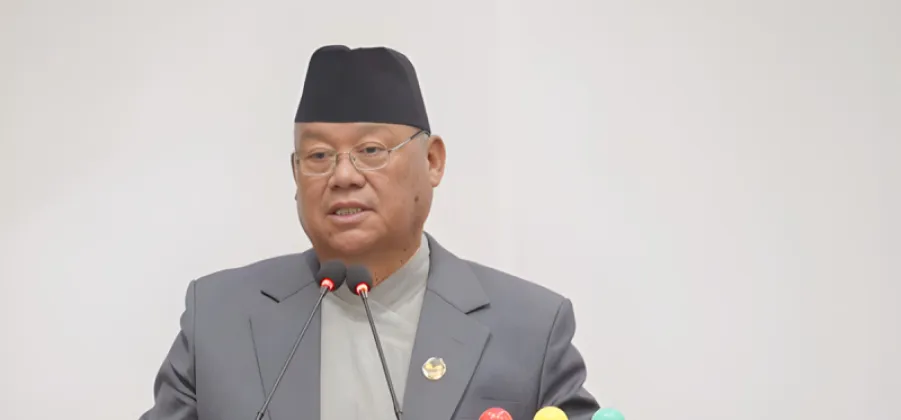
Nepali Congress parliamentary party leader Bhishmaraj Angdembe has objected to the government’s decision to remove the Inspector General of Police (IGP) while 17 months remain in the police chief’s term, questioning why the government considers an early change necessary. He said removing the IGP through what he described as a web of plots and conspiracies was not good governance, but a display of power.
Angdembe challenges the timing
Angdembe’s objection centres on the remaining period of the IGP’s term. He asked the government to explain the compulsion behind removing the police chief before that term is complete, arguing that the decision should not be treated as an ordinary administrative change when so much time remains.
His question puts the timing of the proposed removal at the centre of the political dispute. Rather than focusing only on the government’s authority to make a change, Angdembe challenged its stated or unstated reason for doing so now. His remarks, as reported by Nagarik News, highlight the contrast between an IGP’s remaining tenure and the government’s decision to end it early.
The 17-month figure is central to Angdembe’s criticism: he is asking why the government would remove the incumbent before the term has run its course. The available reports do not provide a detailed explanation from the government for the decision, nor do they identify additional grounds for the proposed change. Angdembe’s remarks therefore focus on the question of necessity and on the way the decision is being pursued.
‘Not good governance’
Angdembe also criticised what he characterised as a process built on plots and conspiracies. In his view, removing the IGP in that manner would not amount to good governance. He described it instead as a show of power, presenting the decision as an issue of how authority is exercised as well as when it is exercised.
That distinction is at the heart of his public objection. Angdembe is not merely asking why the government has chosen to make a change before the end of the term; he is also challenging the approach he says has been used to bring it about. His argument is that an early removal pursued through manipulation would undermine the standard of governance the government should uphold. Nepal Press reported his criticism of the move as a display of power rather than good governance.
Angdembe’s comments frame the decision as one requiring a clear public explanation. His question about the government’s compulsion to remove the IGP early calls attention to the gap between the remaining term and the government’s action. He has not, in the information available, set out a separate alternative course or described what decision the government should make instead; his stated demand is for an explanation of why removal before the end of the term is necessary.
Government faces questions over early change
The dispute, as reflected in Angdembe’s remarks, is about both the timing of the change and the conduct surrounding it. The government’s decision to remove the IGP with 17 months left in the term has prompted the Nepali Congress parliamentary party leader to question its justification and to condemn what he calls a web of manipulation. His criticism places the burden on the government to explain why it is proceeding before the term is complete.
For now, the points established in the reports are Angdembe’s objection, the remaining 17 months of the IGP’s term, and his description of the removal process as a show of power rather than good governance. No further details about the government’s reasons or the next steps in the decision are included in those reports.