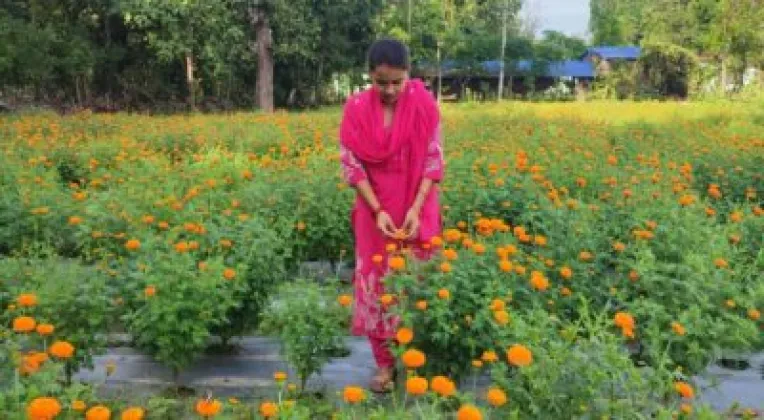
Megha Rawal, a resident of Bhimdatta Municipality-15 in Kanchanpur, has turned four kattha of her own land into a marigold farm, and the early returns have supported her belief that flowers offer better prospects than conventional crops. Rawal, who completed a three-year Junior Technical Assistant (JTA) course in agriculture, planted 2,400 marigold plants on the plot in the far-western district and says flower farming now earns her about twice as much as traditional farming. Her shift into floriculture followed her own assessment that the sector held strong commercial promise, a judgment her first season on the land appears to have borne out.
From classroom to flower field
Rawal's move into flower farming was grounded in formal training. The agriculture JTA course she completed runs for three years and equips students with practical skills in crop production, horticulture and farm management. Rather than letting that training remain theoretical, Rawal applied it directly to her family's holding, converting four kattha of land in Bhimdatta Municipality-15 into a marigold field.
Her choice of crop was equally deliberate. She has said she took up floriculture after seeing good prospects in flower farming, an assessment that shaped both the scale and the design of her planting. The result was a compact but intensive operation, which can be summarized in a few key figures:
- Training: a three-year agriculture JTA course
- Crop: marigold
- Number of plants: 2,400
- Land: four kattha of her own holding
- Reported return: about double the income from traditional farming
The figures underline how little land was needed to make the enterprise viable. Four kattha is roughly 1,350 square meters, around an eighth of a hectare, yet it supports a plant population large enough to generate a meaningful harvest.
Why marigolds
Marigolds hold a secure place in Nepal's flower economy. They are hardy, quick-growing and adaptable to a range of growing conditions, and they sell in volume through the festival season, when garlands and loose blooms are used in homes, temples and public celebrations across the country. For a smallholder deciding what to plant, a crop that combines ease of cultivation with dependable cultural demand is an attractive option, and the planting density of 2,400 plants on such a small plot suggests Rawal planned her farm intensively rather than extensively.
Double the return on a small plot
The central claim in Rawal's account is the income comparison. In her own assessment, flower farming earns about twice as much as traditional farming. The figure is drawn from her experience on her own land rather than from a formal study, but for a smallholder it is a striking margin, and one that goes to the heart of the economic case for moving away from conventional crops.
For farmers in the Tarai, where holdings are often small and fragmented, that arithmetic matters. A plot of four kattha is too small to generate substantial income from staple crops alone, so a crop that doubles the return on the same land changes the calculation entirely. Because Rawal is farming land she already owns, the returns also accrue directly to her household.
Her experience illustrates the practical value of technical education in agriculture as well. The JTA course gave her the grounding to choose a crop, plan a planting and manage it through to harvest, and she has credited the prospects she identified in flower farming for her decision to enter the sector in the first place.
A signal from the far west
Kanchanpur, which lies in Sudurpashchim Province along the border with India, remains an agriculture-dominated district, and Bhimdatta Municipality, which contains the district headquarters of Mahendranagar, is among its more commercially active areas. That Rawal's marigold field has drawn attention from multiple media outlets, including Khabarhub, Ratopati and Nepal Press, reflects a wider interest in stories of young, trained farmers making commercial agriculture work on small plots.
Her case speaks to a common challenge in rural Nepal: turning technical qualifications into a local livelihood. Rawal's answer was to become her own employer, applying her JTA training to land her family already had. The doubling of income she reports will not by itself transform the district's farm economy, but it offers a concrete data point in favor of floriculture as a high-value option for smallholders with limited land.
For now, the 2,400 marigold plants on her four kattha in Bhimdatta Municipality-15 stand as a working demonstration of her argument. With her training behind her and a season of results in hand, Rawal's bet on flowers has so far paid, by her own accounting, roughly double what the same land would have earned under traditional farming.