
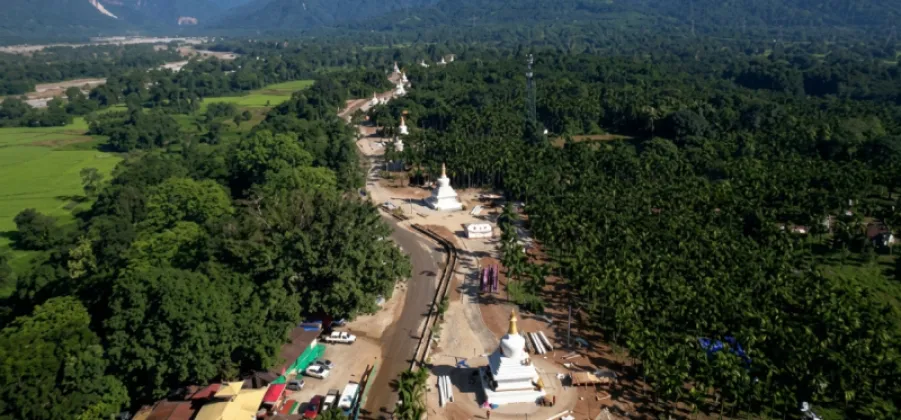
More than 40,000 volunteers in Bhutan built 108 Buddhist stupas in a single day on Sunday, in a striking display of collective devotion and national mobilization. The mass construction formed part of an ambitious plan to develop a "Mindfulness City", a project aimed at accelerating the country's economic development. By turning the building of sacred monuments into a mass public event, organizers wove religious and cultural elements together with the nation's economic goals, offering a preview of the values and the ambition that underpin the wider project.
40,000 Hands, 108 Sacred Structures
The figures involved in Sunday's build convey the scale of the undertaking:
- More than 40,000 volunteers took part in the construction drive.
- 108 stupas were completed within a single day.
- The build took place on Sunday.
- The effort formed part of the plan to develop a "Mindfulness City".
- The project is intended to accelerate Bhutan's economic development.
For a country of Bhutan's modest size, mobilizing a volunteer force of that magnitude is a formidable logistical and social feat. Completing 108 separate religious structures between dawn and dusk required that volunteers be organized into teams, that sites and materials be readied in advance, and that work proceed in a coordinated rhythm throughout the day. That the task was finished on schedule underscores the depth of planning and public commitment invested in the project.
As Nagarik News reported, 40,000 people in Bhutan built the 108 Buddhist stupas in one day, an effort carried out in support of the Mindfulness City vision.
Why Stupas, and Why 108
Stupas are among the oldest and most revered forms of Buddhist architecture. Traditionally dome-shaped monuments, they serve as focal points of devotion, places where the faithful circumambulate, make offerings and meditate. In Buddhist belief, the act of building a stupa is itself considered deeply meritorious, which meant that for the tens of thousands who took part, Sunday was as much a spiritual exercise as a construction project.
The choice of exactly 108 structures carries its own symbolism. The number 108 is regarded as sacred across Buddhist traditions: it appears in the 108 beads of the mala used in prayer and recitation, and it recurs throughout Buddhist ritual and teaching. Building 108 stupas in unison gave the day a symbolic completeness, tying a remarkable physical achievement directly to the spiritual meaning the event was designed to express.
Faith and Culture in the Service of an Economic Vision
What set the day apart was not only its scale but its purpose. The construction was staged as part of the drive to develop a "Mindfulness City", an ambitious urban project presented as an engine of accelerated economic development. Rather than separating the sacred from the economic, the event deliberately merged the two: the stupas are religious monuments, but the act of building them advanced the narrative of a nation preparing to grow without abandoning the spiritual identity that defines it.
The "Mindfulness City" concept signals that ambition in its very name. Planners are framing development not simply in terms of infrastructure and output, but around a way of life in which contemplation, community and well-being sit at the center of economic progress. Sunday's mass build offered a working demonstration of that idea: an undertaking of national scale executed through volunteer labor, collective discipline and shared belief.
For Bhutan, a small Himalayan nation long associated with placing happiness and spiritual values alongside material progress, the event fit a familiar pattern. The Mindfulness City project extends that outlook into urban and economic planning, and the stupa-building day gave it a highly visible, popular expression.
A Demonstration of Volunteer Power
Beyond its religious and economic messaging, the day showcased what the country's citizenry can accomplish when mobilized. Forty thousand people did not gather by chance; the event reflected an organizational capacity able to recruit, coordinate and direct a volunteer workforce larger than many towns. It demonstrated a form of national strength that no economic statistic can fully capture: the willingness of ordinary people to devote a day of labor to a shared vision.
The stupas themselves will remain long after the volunteers have gone home. As permanent religious structures, they will stand as physical markers of both the day and the Mindfulness City project they were built to carry into public consciousness. For now, the event stands as a devotional milestone and an economic signal at once: Bhutan has made clear that its path to faster development will run through its culture and its faith as much as through its plans, and on Sunday, 40,000 of its citizens picked up the tools to prove it.


